Skirt Tutorial: By Tammy

Border 25

I really love the versatility of skirts so today I will share one more fun and easy skirt with you along with some hints about professional techniques when sewing clothing. This skirt has it all—easy, gathered, lined, twirly, and (best of all) it has a cute border!) It’s the not-so-basic basic skirt!
Border 23
This skirt is similar to the basic, lined skirt I shared last time so please refer to that tutorial (here) for detailed instructions regarding size information and the general instructions. This one moves a little faster, assuming you have the basic details down, and the sequence is a little different than the last one—I think it makes more sense!

Border Tutorial
Materials
skirt fabric (100% cotton)
border fabric
skirt lining fabric (cotton/poly blend—broadcloth works well)
coordinating thread
3/4 inch elastic
large safety pin

Instructions
Cut out waistband, two skirt pieces, 2 border pieces and 2 lining pieces
Border 1Border 2
Length and Width of Fabric Pieces for Skirt and Lining
****************
I need to clarify length and width issues with this tutorial. Because of the way the fabric is cut to use the fabric efficiently, this is how I define “length” and “width” which is actually kind of backwards for the actual skirt. Stick with me, though!
Each of these pieces was cut in a strip (from selvedge to selvedge on the fabric) for the width of each piece and then cut smaller along the length to make the right length for each piece.
Border Measurements
This is how my fabric looked when I cut out the waistband and skirt pieces:
Border Fabric
Length and width of the actual skirt would be the opposite, so don’t get confused.
****************
Determining size for the waistband:
Length = 1 1/4 times actual waist measurement.
Width = approximately 1/4 of the overall length of the skirt plus 2 inches seam and casing allowances.
Determining size for the skirt pieces:
Length = 2 times the actual waist measurement
Width = total skirt length (waist to finished length) minus the waistband width (when sewn) minus desired border width (part that shows– i.e. 2 1/2 inches for mine) plus seam allowances of 1 1/4 inches
Determining size for the lining pieces:
Length = same as skirt piece length
Width = same as skirt piece width minus 1 inch
Determining size for the border pieces:
Length = same as skirt piece length
Width = desired width of border (2 1/2 inches for me) times 2 plus 1 1/4 inches for seam allowances.
**Sew with a 5/8 inch seam allowance unless otherwise stated.**
Sew Skirt Lining
With right sides together (RST), sew lining pieces together at sides. Press flat.
Border 3
Hem lining by turning up 1/4 inch and pressing flat. Turn up another 1/2 inch and press flat.
Stitch in place near edge.
Border 4
Sew Skirt
With RST, sew the skirt pieces together at sides. Press seams flat.
Border 5
Sew Border Section
With RST, sew the border pieces together at sides. Press seams flat.
Border 6
Fold border in half lengthwise, matching raw edges and press.
Border 7
Attach Border
Sew border section to right side of skirt section keeping the raw edges and seams lined up.
Border 8
Press seam flat with seam allowance laying towards the top of the skirt. Topstitch close to seam.
Press along seam another time.
Border 9
**PROFESSIONAL QUALITY HINT**
I have seen a growing trend in tutorials to sew borders (and ruffles) onto the skirt section first—before the side seams are sewn. I also see this a lot when making armholes for sleeveless dresses and shirts. This makes sewing your clothing much easier because you are attaching borders and ruffles (or turning in hems on curves) when everything is flat. Then, you go back and sew the side seam(s) all at once and everything lines up perfectly. This would work, except…it looks so awful. I urge you to take the time to make your clothing look great. The extra time pays off! Besides, after spending the time to make a handmade item, why would you skip steps that shave off just a few minutes and a lot of professionalism?
I made an example using a very small piece of fabric so you can clearly see the problem. I’m borderline stingy with fabric so this looks like a skirt/border for a small snake. Just use your imagination. This is how the skirt/border would look if you sewed the border first and sides seams last. Notice how your seam allowance is wagging around and possible visible. Eww!
Border 26
Even worse when I serged it—one, because it was thicker the serger “pushed” it and the seam is definitely visible, and, two, there is no way to backstitch with the serger so you would have to tie off the end. Possible, but still not pretty and a waste of time since it can be avoided by doing it more professionally in the first place!
Border 27
Join and Gather Skirt and Lining Sections
Place wrong sides together on skirt and lining sections.
Gather through both pieces. Go HERE for more details on gathering.
Border 13
Sew Waistband
With RST, sew the short ends of the waistband together. Press seam flat.
Border 10
Make a casing for the elastic. Fold over 1/4 inch and press in place.
Fold over again, 1 inch, and press in place.
Border 11
Flatten the waistband piece with the side seam along one side. Fold in half again and use a pin to mark this halfway point. It will mark the center of the back of the skirt.
Sew in place close to the edge leaving a 2 inch opening around the center back.
The opening is for inserting the elastic.
Border 12
Sew Waistband to Skirt Section
Insert skirt into waistband with RST.
Match side seams and pin in place, adjusting gathers so they are evenly spaced along waistband.
Border 14
Sew waistband to skirt.
Border 15
Turn right side out and press seam with seam allowance laying towards top of skirt.
Topstitch along seam line. Press again.
Border 16
Insert Elastic
Insert 3/4 inch elastic into casing and sew casing closed. The length of the elastic should be smaller than the actual waist measurement. There are a lot of different ideas about how long it should be, but I typically use the waist measurement minus 3 or 4 inches and it seems to work pretty well. If it is too big, make sure you wash the skirt once or twice before you tighten the elastic—it definitely stretches when you are inserting it into the casing.
Border 17
And…it’s done!

Border 21

I won’t lie—I am totally in love with this one!
I let my daughter choose the fabrics. She picked the polka dot fabric and I told her I wanted to put a border on the bottom. She had no clue what I was talking about so I asked her to pick another fabric to go with it. She picked the floral and I was ecstatic because the fabrics actually matched! If I was choosing, I would have made the floral the skirt and the polka dot the border, but I actually love the way it turned out! Shows what I know, huh?
I also love the lining.
A lot of skirts aren’t lined, but it is so easy to add a lining and it makes a huge difference in the quality—and when it is windy! {wink!}Border 22
This skirt is perfect for playing and posing–or not posing when you are supposed to be posing!
Border 19Border 18
If you have any problems or questions (or compliments!), please feel free to hop on over HERE and let me know.

Basic Lined Skirt: By Tammy

Basic 2 Skirt 32

After talking about gathering techniques to get everyone ready for spring skirts, there is no way I could skip making a spring skirt for this series! Unfortunately, around here we don’t have spring weather yet, but there is no reason we can’t pretend a little! Besides, it goes perfectly with Stacy’s current “Point of View” series!
Basic 2 Skirt 27
This is one of my favorite skirts—lined, twirly, and best of all, no bulk at the waist.
Basic 2 Skirt 28
There are so many variations on this skirt out there, but I think it is a good idea to start with the basic, lined skirt and then you can change it up any way you would like. I love to make this skirt in tiered ruffles and use a different fabric for each tier.This design is so simple to change and embellish once you have the basic skirt design down pat so we will start with that for today.
This skirt can be made in just about any size and many different fabrics. I used red text to show the “math,” when figuring out the measurements, but you can substitute your own numbers in those places. I prefer 100% cotton for this style and it is easy to sew with. If you are new to sewing, I suggest sticking with 100% cotton to make the first one and then you can branch out from there. As far as sizing goes, I will share the way to measure your fabric and use my daughter’s measurements as an example.
Basic 2 Skirt Tutorial

Materials
skirt fabric (100% cotton)
skirt lining fabric (cotton/poly blend—broadcloth works well)
coordinating thread
3/4 inch elastic
large safety pin

Instructions
Cut out waistband, two skirt piece, 2 lining pieces
Basic 2 Skirt 1Basic 2 Skirt 2
I like to line skirts—a built-in slip, but this isn’t necessary. The lining fabric is inexpensive and it is easy to line this skirt. I think it improves the overall quality of the skirt, so I just do it every time. If you aren’t lining, just skip those steps.
A TIP: The standard seam allowance for clothes for the home sewer is a 5/8 inch allowance. While this may seem unnecessary, it is actually very wise if you have to make a garment a little larger. It is the standard seam allowance for commercial patterns and is clearly marked on most sewing machines. Obviously, you can sew with any seam allowance you like, but I find it is easiest to stick with this measurement for sewing clothes because it is “standard” and is not likely to change.
Length and Width of Fabric Pieces for Skirt and Lining
To determine the size of each piece, you will need a little math. This section is long, but I think it makes sense and it enables you to make skirts of any size instead of needing a new pattern for each size.  After you do it once, it makes more sense and is really easy to do again and again.
Determining size for the waistband:
The length of the waistband fabric equals 1 1/4 times actual waist measurement.
(Waist = 21 inches so waistband length = 26 1/4 inches)
The width of the waistband fabric equals approximately 1/4 of the overall length of the skirt plus the seam allowance and an allowance for the casing for the the elastic (total of 2 inches seam and casing allowances).
(1/4 the length of skirt 13.5 inches = about 3.5 inches plus 2 inches for seam and casing allowances = 5.5 inches)
The width of the waistband piece can be a little confusing, but remember that it doesn’t have to be precise since you can adjust the length of the skirt a little when you are hemming it. For babies, you might want a slightly smaller width—their skirts are so short anyhow. I use 3.5 inches (plus seam allowances) for the width for sizes 12M up to about 6 and then add an inch or so after that. For teen and adult sizes, you would probably make it a little wider, but it isn’t critical.
The most important factor is to get the bulk out of the waist!
Determining size for the skirt and lining pieces:
The length of the skirt pieces should equal 1 1/2 to 2 1/2 times the actual waist measurement. I tend to just double it because it is simple to figure out. Each skirt section should be as long as the waist measurement.
Length = 21 inches long)
NOTE: For this size, this could have been cut out of one continuous section from selvage to selvage on my fabric, but I prefer to have 2 sides seams instead of one seam in the back or one side seam, so I just cut 2 sections.)
The width of the skirt pieces equals the total skirt length (13.5 inches) minus the waistband width when sewn (3.5 inches) plus seam allowances of 1 3/8 inches for all sizes)
Width = length of 13.5 inches – finished waistband width 3.5 inches = 10 inches + 1 3/8 inches = 11 3/8 inches wide
Determining size for the lining pieces:
Length = same as skirt piece length (21 inches)
Width = same as skirt piece width minus 1 inch (10 3/8 inches)
Sewing the Skirt
With right sides together, sew the skirt pieces together at side seams with a 5/8 inch seam allowance.Basic 2 Skirt 3
Press seams flat.
Don’t skip this step—it is the difference between “homemade” clothing and “handmade” clothing!Basic 2 Skirt 6
Sew the lining sections together the same way as the skirt sections.Basic 2 Skirt 4
Press seams flat.Basic 2 Skirt 5
Put lining section inside skirt section with wrong sides together and top edges even. Sew two rows of gathering along the top at 5/8 of an inch and 1/2 or 3/8 of an inch. You will sew through the lining and the skirt sections. Set aside.
Go HERE for more details on gathering.
Basic 2 Skirt 10
Sewing the Waistband
With right sides together, sew the short ends of the waistband together with a 5/8 inch seam allowance.
Mark the lengthwise center of this piece.
Basic 2 Skirt 12
Make the casing for the elastic.
Fold one long edge (length) over 1/4 inch and press in place. Fold over another 1 inch and press again. Stitch very close to the edge. Leave a 2 inch opening in the center of the length (marked in the last step). This will be the center back of the skirt. Your short edge seam (last step) will be one side seam and the other side will not have a seam. It is helpful to mark the side that does not have a seam with a light pencil mark to make joining the waistband to the skirt a little easier.
Basic 2 Skirt 13
NOTE: It is actually easier to put in the elastic after you have joined the waistband to the skirt because everything lays flat. I am not sure why I did it this way, but since you will see it this way in all of the pictures, I kept it in the same order. Sorry about that!
Pin safety pin to end of elastic and feed through the casing you just made. Push and pull the pin along the casing to thread the elastic through. Be sure you don’t pull the elastic all of the way into the casing. You will need to leave a tail sticking out at either end.
Basic 2 Skirt 14
Pull the ends of the elastic out a little making certain they do not get twisted. Sew ends together securely.
Basic 2 Skirt 15
Insert a label, tag, or ribbon to mark the back of the skirt. Finish sewing the casing closed along the edge, catching the ribbon or label as you sew. Be sure you do not sew the elastic down as you sew the casing.
Basic 2 Skirt 16
Joining the Waistband and the Skirt Sections
Place the skirt inside the waistband with right sides together. The top of the skirt sections should be lined up with the bottom of the waistband piece. Pull the gathering stitches to line up side seams and side seam with marking. Adjust the gathers so they are evenly places along the skirt. Pin in place in several places.
Basic 2 Skirt 17Basic 2 Skirt 18
Sew the waistband to the skirt sections. You can sew (using a regular stitch length) right along the 5/8 inch gathering stitch.
Basic 2 Skirt 19
Finish the raw edges with the serger or a zig zag stitch.
Basic 2 Skirt 20
Turn right side out and press along the seam with the seam allowance (inside) facing towards the top of the skirt. If you have any stray gathering stitches showing (like I do), carefully remove them with a seam ripper.Basic 2 Skirt 23
Topstitch along the seam line on the waistband side of the skirt.
This will hold your seam in place and keep it all a little more smooth.
Basic 2 Skirt 24
Hemming the Skirt
Measure the overall length of the skirt. I usually put in a hem that has a 3/4 inch hem allowance (fold 1/4 inch and then another 1/2 inch). Adjust these measurements as necessary.
Fold over 1/4 inch and then another 1/2 inch pressing each fold in place.
Basic 2 Skirt 7
Sew in place along the edge—measure from the right (bottom of the skirt) so your stitching line is even from the front.Basic 2 Skirt 8
Press hem flat.
Basic 2 Skirt 9
Hemming the Lining
Hem the lining in the same manner as the skirt.
When complete, the wrong side of the hems (lining and skirt) will face each other just as the wrong sides of the lining and skirt are together.
If necessary, make the same adjustments to the length that you made to the skirt.
(Remember, the lining is already 1 inch shorter to prevent if from showing.) 

You are done—whew!

Basic 2 Skirt 25
A lot of directions and a lot of pictures, but it is truly a simple skirt to make. If you are new to this, the many directions will be helpful and if you are familiar, you should be able to whiz through it quickly, right?
Basic 2 Skirt 26Basic 2 Skirt 30Basic 2 Skirt 31
I hope you enjoy making lots of skirts for spring!
(Or summer, fall or winter!)

Ruffles!!! By: Tammy

AliSWF4etsy

Michigan is finally beginning to show some signs of spring and we are so excited! With three girls, I am gearing up to make lots of spring and summer skirts. I love skirts for little girls—all of the advantages of shorts, but just a little fancier. Skirts are really easy to make and there are many patterns and tutorials out in Blog Land. Since so many of them are gathered in at least one place, I’d like to share some gathering techniques. This should be helpful for gathering lots of things, not just skirts.
A gathering stitch is a straight stitch set to the longest length on your sewing machine. After gathering and edge, typically that edge is sewn to something else like the ruffle in a skirt or dress.

swf11

You can also loosen your tension dial and it will gather for you as you sew, but it isn’t necessary and I tend not to use it often. The exception might be when you are running one row of stitching down the center of a strip of fabric so it will ruffle like ruffles on this dress: J24
To run the gathering stitch, you can use one, two, or three threads to gather the fabric. Your stitching line is typically 5/8 of an inch in from the edge. To add a second stitching line, I start the second line about 1/4 inch closer to the edge. For three rows of gathering stitches, I space them about 1/8 apart.
Gathering 2Gathering 1Gathering 3
HOW TO: To make the fabric gather, sew the gathering stitches along the edge of the fabric. Do not backstitch at the beginning or ending of the stitching. Gently pull the trailing threads from the top (wrong side) or the bottom (right side)–choose only one–of the fabric to slide the fabric along the threads and push it together into the gathers. The ends tend to be a little less gathered, but I just tighten those as I sew. You can also pull them gently and tie the loose threads into a knot to hold them in place.
Gathering 4
SUGGESTION: I rarely sew a gathering stitch with one line of stitching except as I mentioned before—gathering down the center for ruffles. It tends to pucker and get lumpy otherwise. The telltale sign of clothing that uses only one row of gathering stitching is dresses and skirts that are poofy at the gathers.
EXPLANATION: Essentially, the gathers should lay fairly low in mostly even gathers especially close to the seam. Here is a super simple drawing to illustrate this (don’t laugh!). Both views are side views—don’t get tricked—and while the drawing seems like 2 acceptable styles, use your imagination…the gathers shouldn’t poof out at the seam. Left side, good. Right side, not good.
Sketch

I generally gather with 2 rows of stitching because it is faster than 3 rows and looks almost as goos, but for the items I sell, I use three rows because it really looks better. Here’s an example. Row 1 has 1 row of stitching and you can see how it is a little lumpy. Row 2 has 2 rows of stitching and it looks pretty good. Row 3 has 3 rows of stitching and it also looks pretty good.
Gathering 5
JOINING: To join your gathered edge fabric to the piece it will be sewn to, always line up the edges and put the non-gathered fabric on the bottom. This way, you can control how the gathered edge is going into the machine since it tries to move and pucker.
Gathering 6

For one and two rows of gathering, you will sew as close to the 5/8 inch seam allowance gathering stitch or right on top of it. If you keep the needle just to the left of the gathering instead of the right, you won’t have to pick out any stray stitches on the other side that will show up just under the seam line.
For three rows of gathering stitches, you will notices a definite difference in the way it lays more flat than one or even two rows. I like to sew right between the center and left row of stitching. Then, I turn it over, press the seam flat and use a seam ripper to carefully remove the exposed row of gathering stitches.

Gathering 7

When you gather this way, you are able to sew the two pieces of fabric together while the gathers are very flat and they will be much more even and flat when you are finished which is why I do it this way for clothing I sell. It is definitely worth the extra time it takes to remove the additional row of gathering stitches and, since they are long stitches, it is relatively easy to do. But, I admit, for regular stuff, I usually use two rows which is far better than one lumpy row.
WHAT’S YOUR VOTE?
I sewed as carefully as I could and tried to make each sample look as good as possible for this little test. Even still, I think the 2 and 3 rows of gathering stitches came out much better than the one row.
You can see that the 2 and 3 rows samples are pretty close, though.
Gathering 8
Up close and personal—pay attention to the way the gathers look right up next to the seam especially:
Using one row of gathering stitches:
Gathering 9
Using 2 rows of gathering stitches:
Gathering 10
Using 3 rows of gathering stitches:

Gathering 11

I hope this helps as you gather skirts, dress, ruffles and other stuff. When I was a little girl and my mom was sewing clothing for me, it was always really important that clothes didn’t look “homemade.” I don’t really know what the distinction was for me since my mom was really good and my clothes looked professionally made. Now, sewing your own clothing is popular and “homemade” is a badge of honor, but it should always represent professional craftsmanship not telltale signs of being sewn at home.
And, that is what I am always striving for (that and hoping my sewing is better than my drawing! {tee-hee})AliSWF2

Funky Frame Tutorial

I love power tools and one of my favorites is my jig saw. I used it the other day to make this super funky frame! (other things I made using a jig saw are: planter box, circle lamp, bathroom mirror, pencil bedposts in kid’s room)

I had some scrap pieces of MDF left over from a counter top I made so I thought why not cut out a frame? I made a template out of paper.

I bought a dollar store frame to use as the back so I needed to trace the opening.

Then I traced the template on the MDF board. You could use any scrap of wood you have. If you don’t have a scrap piece you can buy small boards at any home improvement store.

It is easier if you cut out the center first. I drill a hole in one of the corners so the blade of the jigsaw has a starting point.


After the center is cut go ahead and cut the shape of the frame out.

It will not be perfect but that is when the sandpaper comes into play. Sand down the edges to smooth everything out. This pictures is before I sanded. I forgot to take one of after.

I painted it a bright white. I always ALWAYS use foam brushes. You get a much smoother finish than with a bristle brush. Mulitple thin coats are better than a couple thick coats. You can spray paint it as well.


I currently don’t have a router or else I could have routed out a groove on the back for the glass and picture to set in. But a $1.00 frame from the craft store work great too. I just glued it onto the back.

In hind sight, I probably should have glued it before I painted. The gap would have been less noticeable. But I just painted along the seam and it was fine.

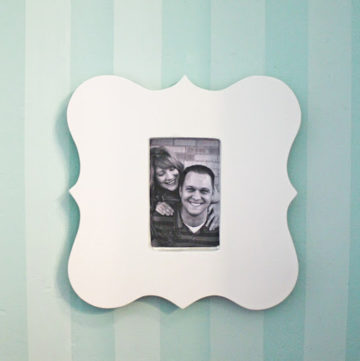
And there you go! I apologize for all the shadows. I was working with zero natural light here. But you get the idea :)

Don’t you want to go out and buy a jig saw??? They are only about $20 bucks. . . I’m just sayin’.

Pin It

Reversible Bucket Bag: By Tammy

Photobucket

I am here to tell you how many projects failed this time around—for a variety of reasons! This Reversible Bucket Bag was created out of the ashes of those failures, though, and it turns out that I love it! I made it reversible because I am a little addicted to the idea of reversible things even if it is never reversed!

Bucket Bag 38
The background: I am not good at clothes upcycling. When I have something that we have outgrown, I can’t stand to cut it up. I donate it hoping that others will love it as much as I did. If I hated it, I donate it and don’t usually want to see any part of it again! With three quickly growing girls, I have found that most stuff gets donated, but I forgot about our clothes—Mom and Dad! We cleaned out our closet several weeks ago and I saved a bunch of things for undetermined projects. And, that’s when I got this idea to build on some projects I was working on!
Unfortunately, I didn’t have the right type of pants for this purse—I really wanted that pocket! We have a brand new Goodwill store in our town, so I headed right over there for a little shopping. I found the pants (look for the largest size men’s cargo pants you can find) for only $4 and the shirt came from my husband’s side of the closet! You can actually use regular fabric for this bag, but it isn’t as much fun!
Tutorial Picture
–Materials–
1 pair of cargo pants with pocket on the side
1 button-down shirt
sew-on Velcro
coordinating thread
pattern
–Instructions–
Make a pattern.
Make a pattern for the bag. I made mine on newspaper. It is essentially one big piece, but I added the curves after I made a bunch of bags without them so my pattern is pieced together. Using the pants, you won’t cut it out in one piece, so you could probably make the handle separately if you would like to do it that way. You will want to make the bottom edge of the handle extend 1/4 inch beyond the bottom edge in the pattern because you will be attaching it to the bag.
Click on the pattern picture to print the curved handle section. Print landscape without page scaling or fit to page options.
Curves for Bucket Bag
Use this diagram combined with the pattern picture above (actual size) to create the full pattern. You can choose the length of the handle. (Mine was about 10 inches long on the pattern which makes it about 19 1/2 inches long on the bag.)
Diagram for Pattern
Cut out the bag.
Center pattern over pants pocket leaving at least 1/2 inch all of the way around the pocket. One side should be placed on a fold. I realized that the shape of the pants leg made a perfect purse shape, so I just went with it. You can see how the pattern fits in relation to the pants leg.
Bucket Bag 1Bucket Bag 2Bucket Bag 3
Cut out the lining.
Use the piece you just cut as a pattern to cut the lining section out of the shirt. Be sure one side has a fold in it and the other side has an extra 1/4 inch of fabric. The shirt piece will be the lining. I went over the button placket a tiny bit, but it was within 1/4 inch and became part of the seam allowance. NOTE: Because this is a plaid, you should really take care to match the plaid and turn everything the same way. For this project, I threw all caution to the wind and just stuck it on there.
Bucket Bag 4Bucket Bag 5
Sew the bottom edge of the bag.
Be sure to turn it inside out with right sides together.
Bucket Bag 11
Make a flat bottom for the bag.
Pinch the bottom corner so the seam is centered and the corner makes a triangle. Flatten the triangle and sew across the bag about one inch from the end of the bag or point of the triangle. Trim off the excess so there is a 1/4 inch seam allowance. Repeat for the other side of the bottom of the bag.
Bucket Bag 12Bucket Bag 13Bucket Bag 14
Sew the lining.
With right sides together, sew the edge of the lining piece using a 1/4 inch seam allowance.
Press seam flat.

Bucket Bag 9

Sew the bottom edge except leave an opening in the center large enough for your hand to fit through.
Bucket Bag 10
Make a flat bottom for the lining.
Do this the same way you did it for the bag. Do not sew the opening in the center.
Add velcro closures to the pocket—optional
I ripped the buttons off my pocket because it wouldn’t open and close easily. For a purse, I want the pocket to open and close easily so I can slide things in and out with one hand. I sewed velcro over the buttonholes and added one in the center to be more certain things won’t fall out of my pocket when I am slinging my purse around.
Bucket Bag 17
Add a ruffle to the pocket—optional
I also added a ruffle to the pocket. Cut the button placket off of the shirt. If you use the side with the buttons, just carefully cut off the buttons. I used the side with the button holes. The arrow shows where I cut it from the shirt. This edge will be raw which means it might fray, but it is so tiny I don’t think it will matter. Use scissors with small, sharp points to be able to cut very close to the placket.
Bucket Bag 18Bucket Bag 19
Hem the end that was cut off of the collar by turning it under twice and sewing along the edge. Using a long stitch (gathering stitch), sew down the center of the placket from top to bottom. Do not backstitch at either end. Try to stay just to the left or the right of the buttonholes.
Bucket Bag 20
Gently pull the thread tight to gather the placket into ruffles. It should be about the same length as the width of the pocket flap.
Bucket Bag 21
Change back to regular stitch length and sew the ruffle to the pocket flap. Sew down the center on top of the gathering stitch. The ruffle will also cover up the little stitched squares where the velcro was sewn. (Ignore the handle—I sewed it first, but it would have been easier to attach the ruffle without it getting in the way.)
Bucket Bag 22
Cut out handles.
Cut 2 handles from each of the fabrics—pants and shirt. I just cut the handle about 1/4 to 1/2 inch longer at the bottom by the curves. It wasn’t very precise, but it was forgiving. It gave me a little extra room to work with when I sewed the handles to the bag and lining. Don’t worry about the grain line or stretch of the fabric since the purse doesn’t need to stretch any direction.
Bucket Bag 7Bucket Bag 8
Sew handles to bag and lining.
With right sides together, place lengthwise center of handle on top of the center of the pocket. Pin in place. Sew in place using a 1/4 inch seam.
Repeat for the handle on the other side by placing the center of the handle over the center of the back of the bag.
Press seam flat with seam towards the top of the bag or lining.
Bucket Bag 15Bucket Bag 16
Repeat for the lining section.
Sew bag to lining.
Place the bag inside the lining. The bag will be right side out and the lining will be inside out. This way, the right sides are together.
Bucket Bag 24
Sew around the top of the bag with a 1/4 inch seam allowance. Start about 2 inches below the top of one handle and sew down and around the curve up to the other side, stopping about 2 inches before you get back to the top.
Repeat for the other side of the handle, but leave an opening large enough for your hand to get through. Be sure to make the opening above the curve on your bag. It is easier to sew the entire curve and work with straight lines later.
Diagram for sewing
(click to enlarge)
Clip the curves by making small snips about 1/4 inch apart along the curve. The snip should go from the edge of the fabric almost to the stitching. Be sure you don’t cut through the stitching.

Bucket Bag 25

Turn right side out.
Reach in through the opening in the lining and gently pull the bag and handles through the lining. Your bag should look like the finished bag except the handles are not sewn and you still have 2 openings.

Bucket Bag 27Bucket Bag 28

Sew opening in lining.
Now reach in through the opening in the handle and pull the lining out of the opening. It will be inside out. Smooth and finish sewing the opening in the bottom of the lining. Gently push it back through the opening in the handle. This is what makes the bag reversible—you can’t see any stitching.

Bucket Bag 30Bucket Bag 29

Join handles together.
Smooth the handles flat and make sure they are the same length. You may need to trim them a bit.
To sew the handles together, you need to put right sides together and sew across the top of the handles. This is easy to do with the lining.
Press seam flat.
Bucket Bag 32
It is a little trickier with the bag handle because you have to get the lining sections out of the way. Be sure to put the right sides together on your handles and then twist the lining out of the way. This way you are sure to sew it together correctly.
Bucket Bag 33
Press seams flat.
Bucket Bag 34
Finish opening in handle and topstitch bag.
Fold 1/4 inch seam allowance to the inside and press in place along the handle at all openings. Pin closed so the openings do not pull and pucker as you sew.

Bucket Bag 35

Press all edges carefully. This will help hold the openings in place and keep the lining where it should be as you sew.

Bucket Bag 31

Topstitch all along the top edge and handles of the bag. I use a 1/8 inch seam allowance for this so that I am sure to catch in all seams—especially in the openings. I also leave the pins in until the last second to help hold it all in place.
Press again to smooth out the stitching.

Bucket Bag 36

That’s it!
It seems like a lot of instructions, but it really goes pretty fast.
Now you have a bag with options!
Color options:

Bucket Bag 42Bucket Bag 44

Pocket options:

Bucket Bag 43Bucket Bag 46

Carrying options:

Bucket Bag 41Bucket Bag 39

I hope you enjoy making one of your own! 

Go check out Tammy’s blog She Wears Flowers for more awesome ideas!

Photobucket